What is pasture poultry?
·14 min read·Steven
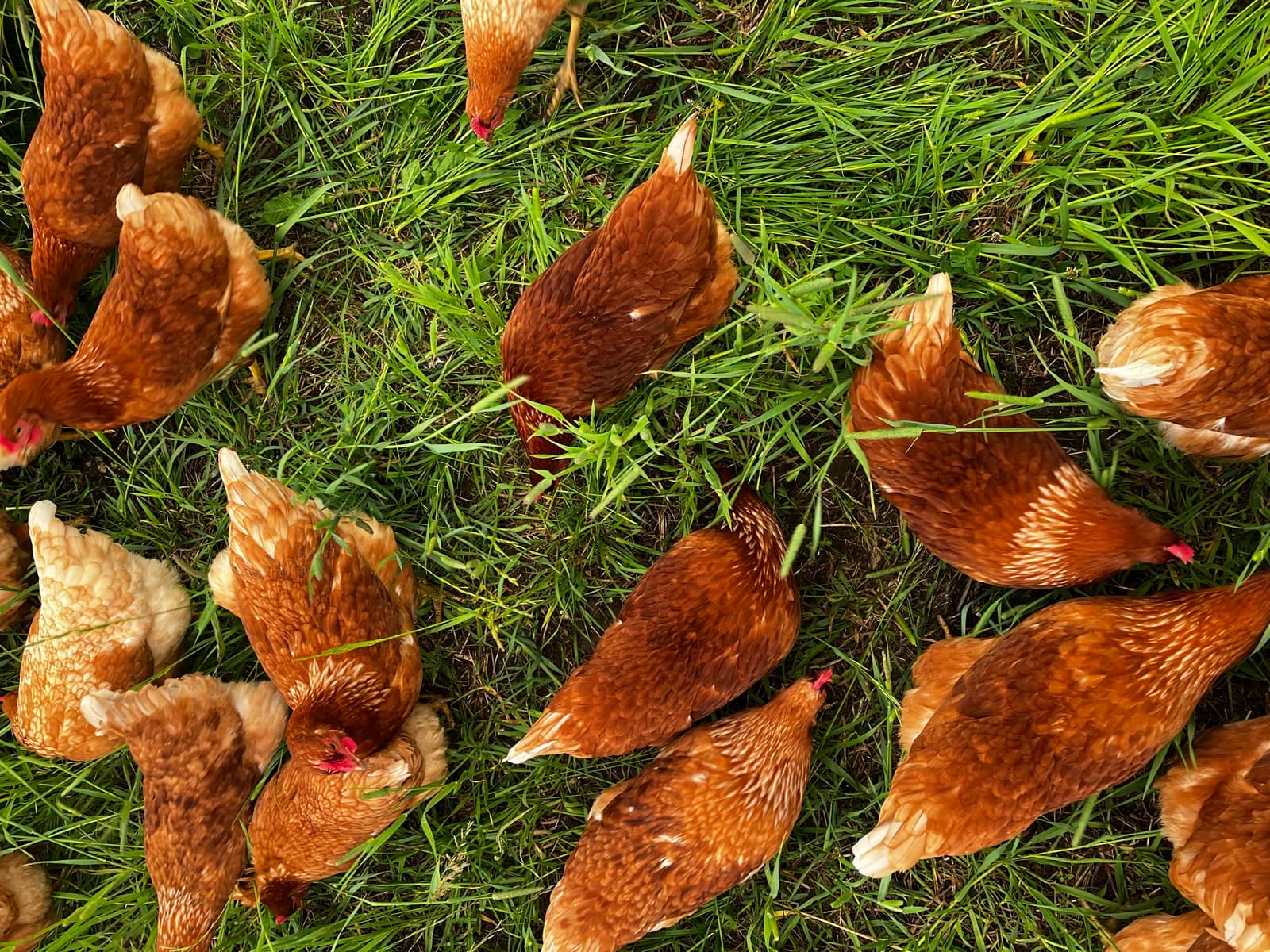
Pasture poultry means keeping hens on living, growing pasture and moving them onto fresh ground every day. They round out their feed with the vegetation, seeds, and insects they find there, and they get to behave like chickens: scratching, foraging, and dust-bathing. Movement is a key characteristic that sets pasture poultry apart from free-range and organic standards.
We're Steven and Johannes. In January 2025, we moved onto Johannes's sixth-generation family farm in Kuusjoki, in Southwest Finland, and started transitioning toward regenerative agriculture. Our first enterprise is pasture poultry. Specifically, we're starting with 1,400 laying hens that we move every day to fresh pasture.
People ask us what pasture poultry actually is. In order to answer this, one must understand there are a few ways to raise hens for egg laying: caged, barn, free range, organic, and, of course, pasture poultry. So, in this post, we cover what pasture poultry is, and isn't; what it looks like day to day at Wiberg's; what it does for the soil; what it means for the hens; and what you'll notice in the eggs.
What pasture poultry is, and isn't
At its simplest, pasture poultry means keeping birds on living vegetation and moving them across it, so the flock is always on fresh, growing ground instead of working the same patch over and over. The hens have grass, clover, herbs, and the insects that come in front of them every day, never a bare run or an indoor floor of slats or wood shavings. It works for laying hens and for meat birds alike.
Movement is key. Free range and organic give the birds vegetation too, but these standards do not require movement, so their housing typically stays put. What sets pasture poultry apart is that the ground keeps changing under the flock, and that movement is also what lets the birds build the soil and regenerate the land (more on this below). Pasture-raised isn't a legal designation with a rulebook, like the other production methods; it's a practice, and the practice is the moving.
Before we started as pasture poultry farmers, we couldn't have told a pasture egg from a free-range or organic one ourselves. In free-range and organic systems, the birds can get outside, and the run is meant to be mainly covered with vegetation [2]. What's harder to know is the real state of that run. Around a fixed house the ground near the outdoor access gets crossed and scratched bare within days, faster than the plants recover, because the same birds work the same patch every day. So it's worth understanding the production system and the particular farm behind your eggs.
Here is an overview of the other methods used to produce eggs in Finland:
- Caged. Hens kept in enriched cages indoors, each with a defined space plus a nest, a perch, and a small scratching area. No outdoor access. (The older battery cages have been banned across the EU since 2012.) [1]
- Barn. Hens uncaged but kept indoors, free to move around the floor with perches and nest boxes. No outdoor access. [1]
- Free range. A barn house plus daytime access to an outdoor range that, by law, must be mainly covered with vegetation. [2]
- Organic. Free-range conditions plus organic rules: organic feed, smaller flocks, lower indoor density, and an outdoor run that must be mainly covered with vegetation. [3]
What does this look like in Finland? According to the Natural Resources Institute Finland (Luke), barn systems produced 68% of Finnish eggs in 2024, enriched cages 21%, organic 6%, and free range 4% [4]. The shift is ongoing: through 2025, barn production kept climbing and cage production fell again [4]. Pasture-raised isn't a separate line in those figures at all.
Here's how the systems line up, showing the minimum standards each one has to meet.
| System | Outdoor access | Vegetated run | Moved to fresh ground |
|---|---|---|---|
| CagedEnriched cages, min. 750 cm² per hen [1] | |||
| BarnUp to 9 hens per m² of floor [1] | |||
| OrganicMax. 6 hens per m² indoors; 4 m² per hen outdoors [3] | |||
| Free rangeUp to 9 hens per m² indoors; 4 m² per hen outdoors [2] | |||
| Pastured (how we do it)~4.8 hens per m² inside the coops |
A note on the words. Those figures are minimums, and plenty of farms operate above them. In Finland and across the EU, the number stamped on the carton tells you the system: 0 is organic, 1 is free range, 2 is barn, 3 is caged [2]. The codes look like four separate boxes, but the standards operate more as levels. Organic hens are free-range hens kept to stricter rules, so organic sits above free range rather than beside it. An egg still carries only one code, the highest standard it meets, so you won't find one stamped with two numbers. Pasture-raised sits outside these levels. It's a practice, so a pastured flock takes whatever code its housing qualifies for. Our system is designated barn, code 2, because a floorless coop that moves to fresh grass every day doesn't fit the existing designations. Which is exactly why it's worth saying what we mean by it.
What it looks like at Wiberg's
The hens live in three mobile coops, each 16 m by 6 m, built on greenhouse frames you can hitch to a tractor and tow. The coops have no floor and sit right on the grass, so the birds are always standing on living pasture, and the coops are where they roost at night and lay their eggs. About 1,400 Brown Nick hens in all, which works out to roughly 4.8 hens per square metre inside the coops.
Every morning we move them. We hitch up our Sisu Valmet 6600 with a tow bar that spreads the pull across the full width of the coop, drop into crawl gear, and walk the coop sixteen metres onto fresh ground over a little more than three minutes. We have about 15 hectares to work with, which means each strip rests anywhere from two months to a full year before the hens come back to it.
For now, that pasture is inside the coops rather than a fenced run around them. The side walls roll up and down, so the birds get sun and air.
Water rides along: an independent trailer hitched to the coops carries two 220-litre barrels, enough to last three or four days between refills. We feed three times a day: feed never runs short, so the hens eat to their own energy needs rather than fighting over one ration. They also have free-choice calcium to support shell development and grit to help them digest.
Our daily rhythm looks like this:
- 7:00, stock the farm shop
- 7:15, move the coops and give the first feed
- 10:00, collect the floor eggs
- 14:00, the second feed
- 19:00, the last feed, and collect the eggs from the nests
- 21:00, evening check
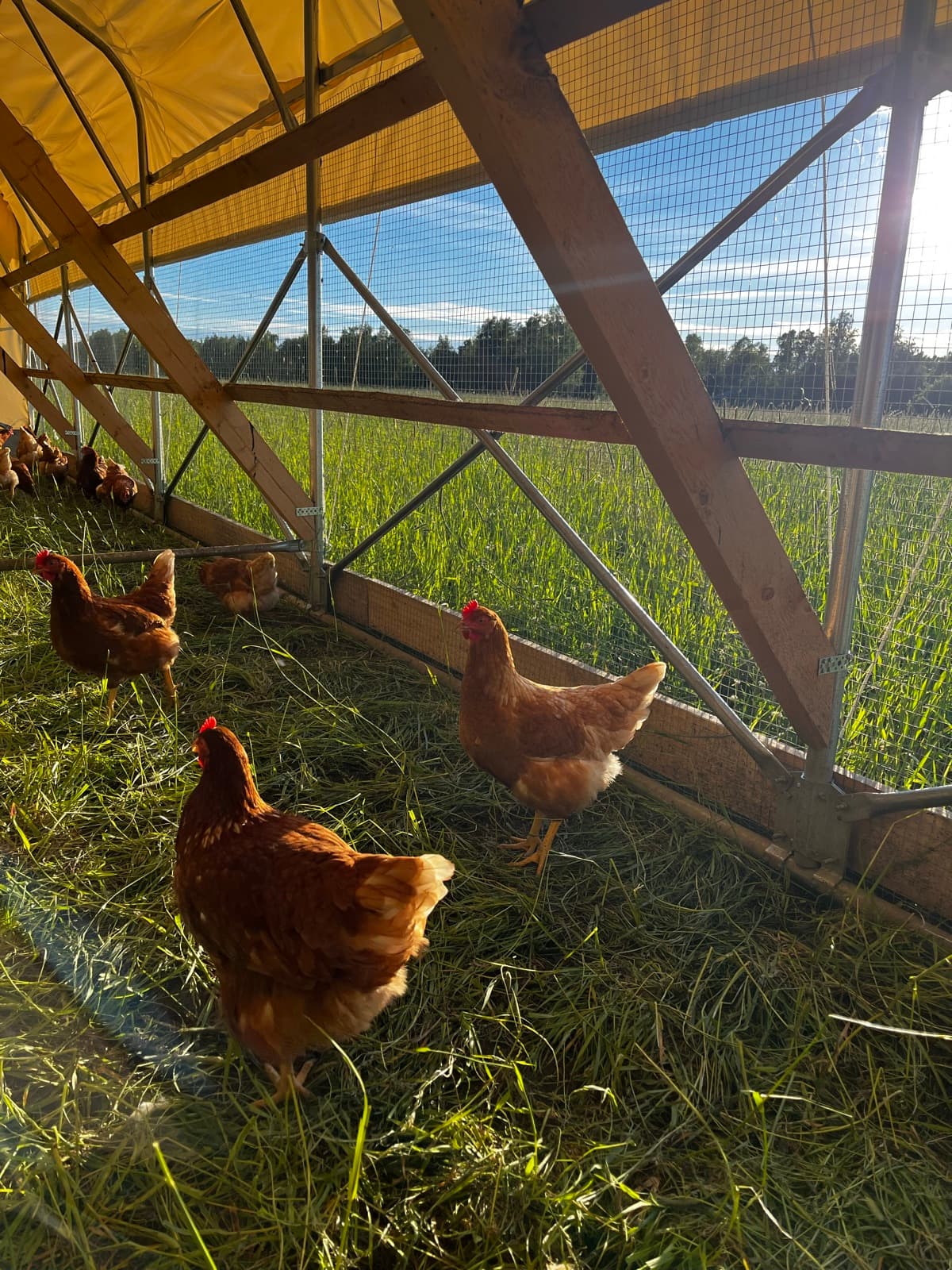
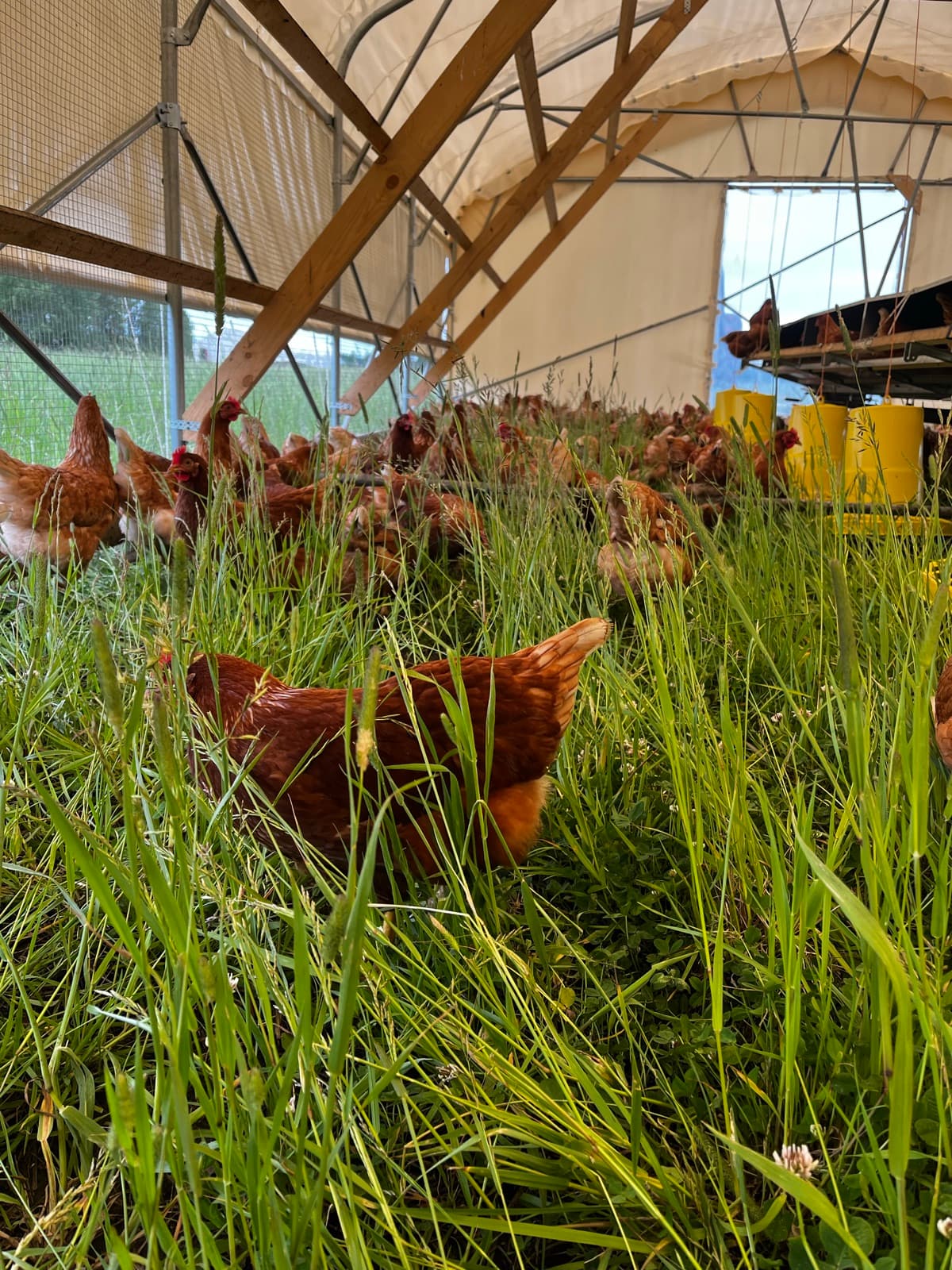
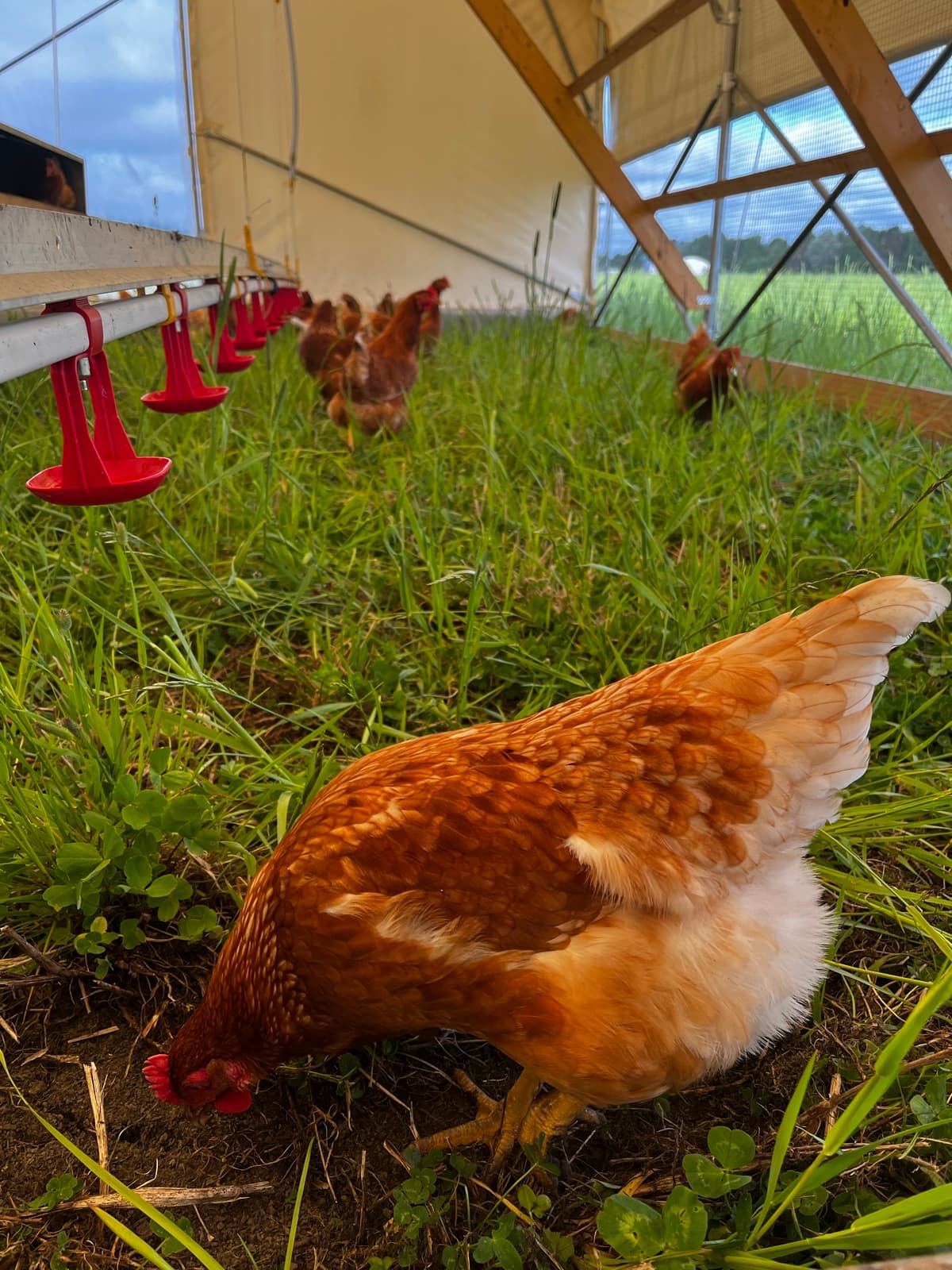
We move the birds every day for two reasons, and they're the next two sections: what it does for the soil, and what it does for the hens.
What it does for the soil
After decades of conventional farming, we see the signs in our soil: compaction, limited nutrients, little organic matter, and water that pools on the surface instead of soaking in. Animal integration through rotational grazing is one of the regenerative practices we're using to improve the land.
Here's how the daily move does this work. While a coop sits on a strip for the day, the hens work it over: grazing the greens, scratching and opening the surface, dropping manure as they go. Then they move on, and that strip gets months, sometimes a full year, with no bird on it. It mimics what herds did on grassland long before we farmed it: hit a particular area hard, then move to the next.
That pattern of short, heavy grazing and long rest is what drives the soil biology. When a grass plant loses more than half its leaf, it stops growing roots for about ten days while it rebuilds the top, and it sheds some living root underground in the process [5]. Losing leaf also makes it pump more carbon out through its roots as exudates, the sugary compounds that feed the microbes around them [6]. Graze again before the plant recovers and the roots never catch up; give it the long rest and it comes back with deeper roots and more leaf, ready to feed the soil again.
Over many cycles, these gains compound. The shed roots and the hens' manure, dropped thin across fresh ground rather than piled in one place, build organic matter and feed the soil [7]. As that organic matter builds, the hard soil pan softens into crumb that finally lets rain soak in instead of pooling. The carbon the plant sends down its roots is carbon pulled from the air. The Natural Resources Institute Finland (Luke) finds that well-managed grass acts as a carbon sink during its growing years [8]. Nutrients cycle back into soil, and the microbes and fungi return, leading to a richer sward, more insects, and the wild birds that feed on them. That is the goal across all 56 hectares of our arable land.
Here's the distinction that matters. Hens get living vegetation in organic, free-range, and pasture systems alike, and it improves their welfare, rounding out their diet and giving them room to behave like birds. In Finland, only about 10% of eggs come from hens with outdoor access [4]. Vegetation feeds the hens; movement feeds the land. Moving the birds across fresh pasture every day is the part you can measure in the soil over time, and it's the whole reason we farm them the way we do.
We say this only to make the distinction between organic and free-range. These eggs are still awesome, especially compared with caged and barn eggs, which still make up the vast majority of eggs in Finland.
What it means for the hens
Put a hen on living pasture and she spends her day doing hen things: foraging, scratching, pecking at plants and insects, dust-bathing. It brings us a lot of joy to watch our hens behave this way. Across a study of 61 free-range and organic flocks, good foraging came up again and again as one of the strongest things keeping feather pecking down [9]. A bird busy working the ground isn't taking it out on the bird next to her.
Fresh ground every day is also a kind of hygiene. The birds aren't standing on yesterday's droppings, so the parasites and pathogens that build up on a static, never-rested run don't get the same chance to accumulate. And because the coops are netted and roofed, our hens don't mix with wild birds, which keeps disease pressure down, avian influenza included.
And then there's the obvious stuff: space, daylight, fresh air. They get to be chickens.
What you'll notice in the eggs
The first thing you'll see is the yolk. Hens eating green forage take up carotenoids that deepen the colour, so a pastured yolk tends to sit darker and more yellow. That part you can see for yourself. And, because we sell eggs to you within a week of laying, the white sits up firm and the yolk stands tall in the pan, the way a properly fresh egg does.
The rest is harder to see, and worth being careful about, since we haven't tested our own eggs yet. A study from Penn State, in the US (where Steven went to university), compared eggs from pastured hens against eggs from caged hens on a standard commercial diet, and found in the pastured eggs roughly twice the vitamin E, more than double the total omega-3 fats, about 38% more vitamin A in the yolk, and a much lower ratio of omega-6 to omega-3 [10]. Outdoor access raises vitamin D too, because a hen in sunlight makes it herself and passes some into the egg [11].
These differences come from what the birds eat, or what they have access to. An egg is only as good as the forage and feed the hen eats. The exact nutrition and composition of the eggs change with the season and the state of the pasture [12]. We tell you what we feed our hens, and how they live, and let the egg speak for itself.
Where to buy
You can get our eggs three ways:
- At the farm kiosk, open daily 7 to 21 at Ylikulmantie 459, Kuusjoki.
- In person at one of our collection points, while supplies last.
- Through your REKO ring, where you order in the ring's Facebook group.
We sell while the hens are out on pasture. Prices, stops, and the dates for this season are on the how to buy page.
References
- Council Directive 1999/74/EC laying down minimum standards for the protection of laying hens (enriched cages, min. 750 cm² per hen; barn max. 9 hens/m²; battery cages banned from 2012). eur-lex.europa.eu
- Commission Regulation (EC) No 589/2008, marketing standards for eggs (carton codes 0–3; free range max. 2,500 hens/ha, i.e. 4 m² per hen outdoors; runs mainly covered with vegetation). eur-lex.europa.eu
- Regulation (EU) 2018/848 on organic production (outdoor access required and mainly vegetated; max. 6 hens/m² indoors; 4 m² per hen outdoors; max. flock 3,000). eur-lex.europa.eu
- Natural Resources Institute Finland (Luke), Egg Production Statistics, Q4 and year 2024 (barn 68%, enriched cage 21%, organic 6%, free range 4%); 2025 for the continuing trend. luke.fi
- Crider, F. J. (1955). Root-Growth Stoppage Resulting from Defoliation of Grass. USDA Technical Bulletin No. 1102. babel.hathitrust.org
- Hamilton, E. W., Frank, D. A., Hinchey, P. M., & Murray, T. R. (2008). Defoliation induces root exudation and triggers positive rhizospheric feedbacks in a temperate grassland. Soil Biology and Biochemistry, 40(11), 2865–2873. sciencedirect.com
- Jones, D. L., Nguyen, C., & Finlay, R. D. (2009). Carbon flow in the rhizosphere: carbon trading at the soil–root interface. Plant and Soil, 321, 5–33. link.springer.com
- Natural Resources Institute Finland (Luke). Grasslands as a carbon sink (Juurihiili project). luke.fi
- Lambton, S. L., Knowles, T. G., Yorke, C., & Nicol, C. J. (2010). The risk factors affecting the development of gentle and severe feather pecking in loose housed laying hens. Applied Animal Behaviour Science, 123(1–2), 32–42. sciencedirect.com
- Karsten, H. D., Patterson, P. H., Stout, R., & Crews, G. (2010). Vitamins A, E and fatty acid composition of the eggs of caged hens and pastured hens. Renewable Agriculture and Food Systems, 25(1), 45–54. pure.psu.edu
- Kühn, J., Schutkowski, A., Kluge, H., Hirche, F., & Stangl, G. I. (2014). Free-range farming: a natural alternative to produce vitamin D-enriched eggs. Nutrition, 30(4), 481–484. sciencedirect.com
- Seasonal variation in egg nutrient composition under a pasture-based layer hen system. PLOS One (2025). journals.plos.org

Steven
Co-founder, Director of Strategy
No previous post
No next post